Part of the measures against climate change can include CO2 capture and storage as well as negative emission technologies. However, their development is still in the early stages. INFRAS is assessing the potential that these technologies could offer for cantonal climate policy in the Canton of Aargau.
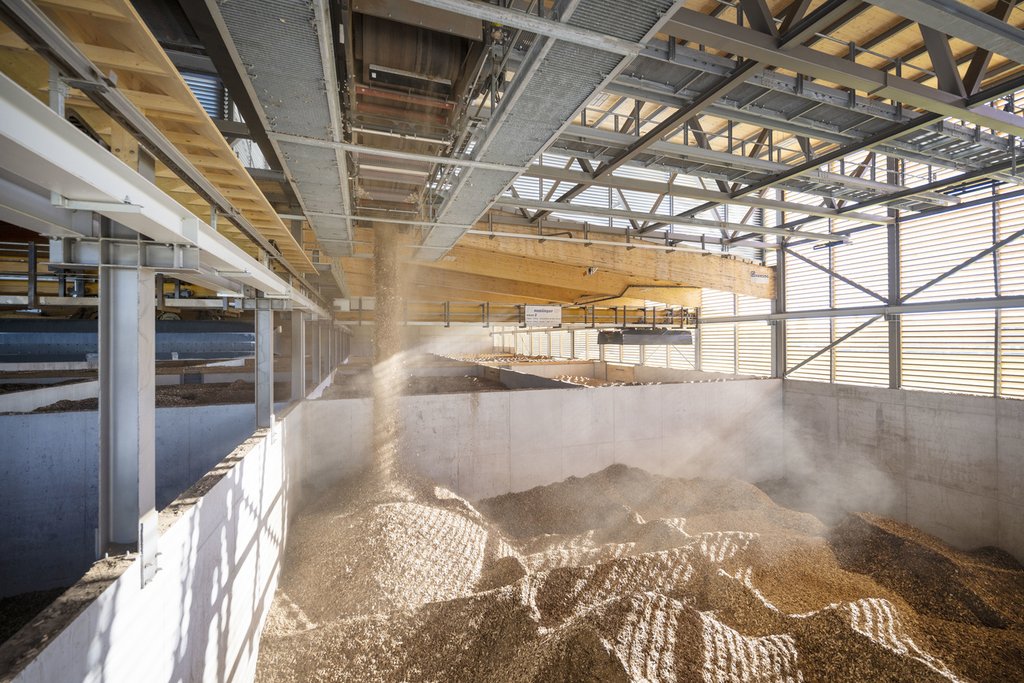
By 2050, the Canton of Aargau aims to achieve net-zero greenhouse gas emissions. Measures to avoid greenhouse gas emissions are essential to this goal, for example through the decarbonisation of transport or the energy sector. Another approach is the capture and storage of CO2 (Carbon Capture and Storage, CCS) before it is released into the atmosphere. In addition, negative emission technologies – referred to increasingly in technical terms as Carbon Dioxide Removal (CDR) – come into play. These technologies can offset hard-to-abate emissions that are difficult to reduce by conventional means. CDR is particularly relevant because, beyond 2050, it will still be necessary to remove more CO2 from the atmosphere than is emitted in order to meet the Paris climate targets.
Analysis of CCS and CDR Technologies
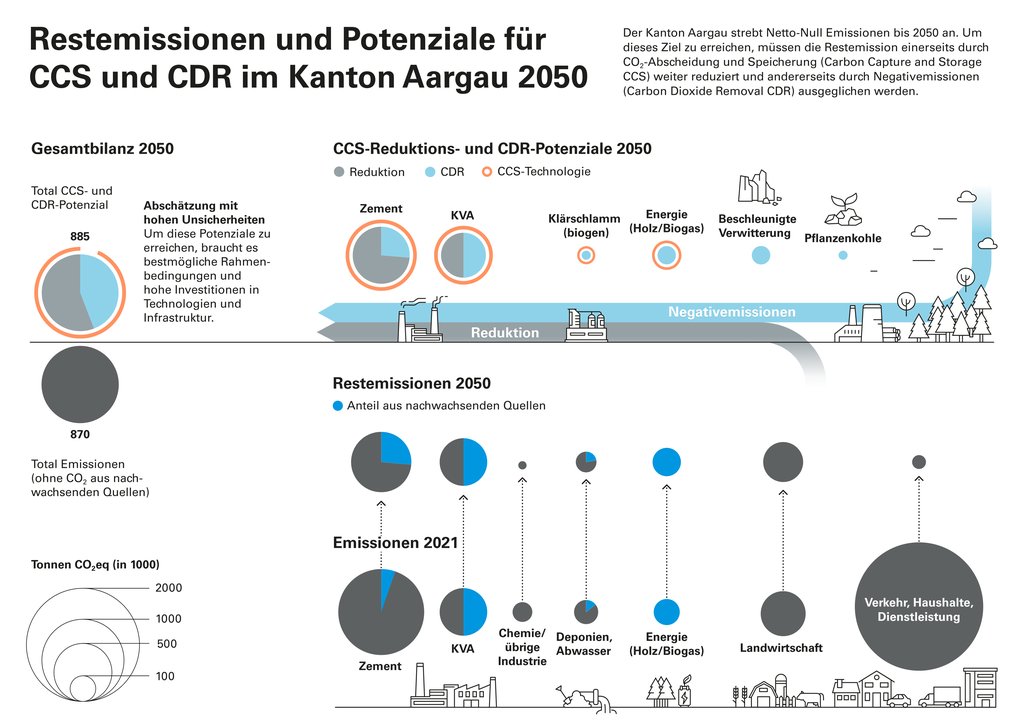
INFRAS conducted a basic study for the Canton of Aargau to estimate hard-to-abate emissions up to 2050 and to assess the potential for reduction and negative emission technologies across various sectors. According to the study, hard-to-abate emissions in 2050 are expected to amount to around 870 kt CO2eq – almost five times lower than in 2021. The majority of these emissions stem from the cement industry, waste incineration, and agriculture. Consequently, these sectors require the most significant action.
The study examined how much CO2 could be captured at the source – such as at cement plants or waste incineration facilities – before being released into the atmosphere, in order to store it long-term underground (CCS). Moreover, INFRAS assessed the potential for Carbon Dioxide Removal (CDR), which could be achieved, among other methods, through the use of biomass for energy production (in combination with CCS) and the application of biochar in agriculture. The analysis took into account concrete logistical, economic, and geographical factors, such as the need for a CO2 transport infrastructure for most CCS applications.
High potential, high costs
INFRAS assumes that the potential of CCS and CDR is roughly on the scale of the hard-to-abate emissions. The Canton of Aargau could thus achieve its net-zero target. «These estimates, however, are associated with significant uncertainties», says Moritz Reisser, one of the study’s authors. «We based our analysis on a best-case scenario under ideal conditions. Achieving these potentials will require substantial effort and high investments in technology and infrastructure.»
Discussions held with the major greenhouse gas emitters in the canton as part of the study revealed that the high costs of CCS are the main stumbling block. In addition, there are many interdependencies. Certain prerequisites, such as the transport infrastructure to CO2 storage sites, are not under the sole control of the Canton of Aargau. «All the more reason to reduce hard-to-abate emissions as far as possible by 2050, so that the costly deployment of CCS and CDR can be minimised», Reisser emphasises.
Although the figures were calculated specifically for the Canton of Aargau, the foundational study is also relevant for other cantons. It exemplifies where the opportunities and challenges of CCS and CDR lie for cantonal climate policy. Future considerations will include, for instance, the efficient allocation of biomass, due to potential conflicts between biogas plants, waste incineration plants, the energy and construction sectors, and the production of biochar.
Further information
National Working Group on CO₂ Removal and Storage
The INFRAS study for the Canton of Aargau showed that good external conditions must be established for the expansion of CCS and CDR – whether in terms of legal foundations or infrastructure and logistics. Collaboration between government levels and the private sector is crucial to this effort. For this very reason, the national working group for CO₂ removal and storage was established in 2022. Felix Weber, head of the relevant INFRAS division, recently presented the Aargau study to the working group, thereby contributing to the identification of barriers to the expansion of CCS/NET and the development of potential solutions.
Weitere INFRAS-Projekte zum Thema
Project team