What will Switzerland look like in the year 2100? How will greenhouse gas emissions develop over the next 70 years? A federal research project identifies possible socio-economic and political developments - and, under the leadership of INFRAS, models potential greenhouse gas emissions.
What will Switzerland look like at the end of the 21st century? How might life in Switzerland evolve socially, economically, and politically? What trends in greenhouse gas emissions and land use will result from this? The «Socio-economic Scenarios» research project of the Federal Government’s National Centre for Climate Services (NCCS), led by INFRAS, addressed these questions. Project partners included the Swiss Federal Institute for Forest, Snow and Landscape Research (WSL), Prognos, and Zoï Environment Network.
Different Futures – Different Ways of Living Together
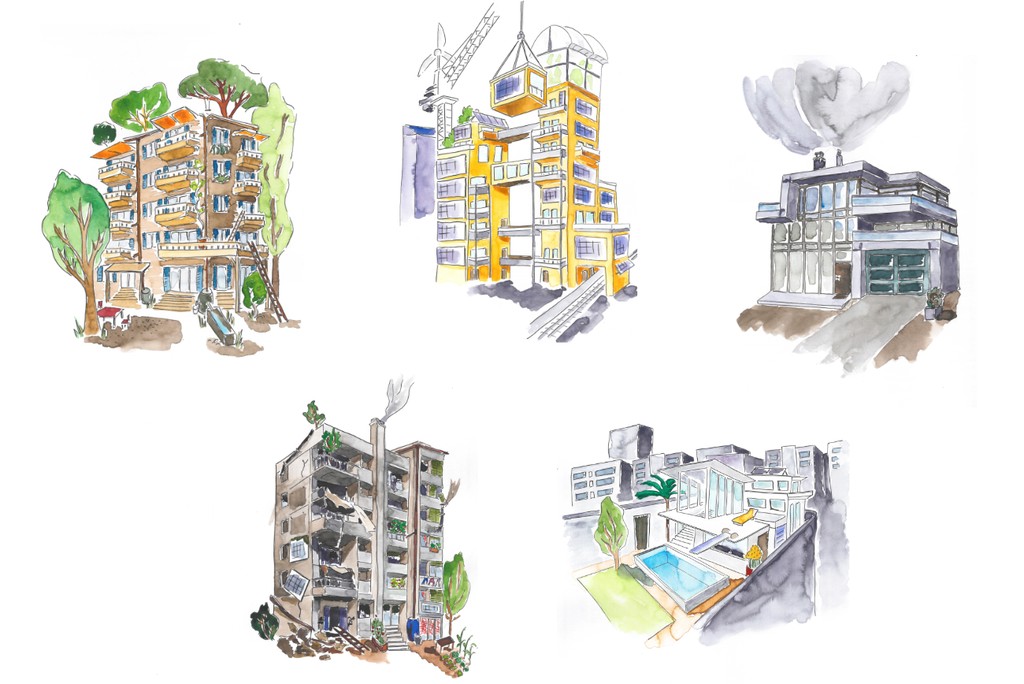
With regard to climate change, the project provides socio-economic and climate policy scenarios for Switzerland up to the end of this century. They outline different possible pathways. The five socio-economic scenarios (SSP-CH) are:
- A society where social cohesion and well-being are more important than economic success and financial prosperity.
- A future with a highly technologically advanced economy and society based on renewable energy.
- A future in which the state and economy are weak and society is falling apart.
- A future in which a deeply divided society pits a small elite against an impoverished population.
- The future of a Switzerland that has long relied on fossil fuels and, by the end of the century, will face the effects of volatile and high energy prices, as well as the costs of a severely degraded environment.
Scenarios as a basis for long-term decisions
Scenarios provide a holistic view of the issue from a socio-economic perspective. A wide range of areas are considered, such as internal security, mobility, spatial development and education. The analysis also addresses questions such as Which current policies in relevant sectors tend to put society on a sustainable development path, and which tend to hinder it? And: What different climate change policies are feasible and effective in the different scenarios? The scenarios provide a basis for long-term strategic decisions, risk analysis, and environmental modeling.
Emissions modeling as part of the project
For the study, INFRAS developed developed the concept of Shared Policy Assumptions (SPA) with different levels of intervention. In addition, INFRAS together with our project partner in cooperation with our project partner Prognos AG models how greenhouse gas emissions and land use in Switzerland could evolve by 2100, depending on the scenario.
Bridging the gap between science and action
The «Socio-economic Scenarios for Switzerland» project is one of six interrelated projects within the NCCS program «Decision-Making Frameworks for Addressing Climate Change in Switzerland: Information on Cross-Sectoral Issues» («NCCS-Impacts»). In the area of climate change mitigation and adaptation, the program bridges the gap between science and action.
Project team